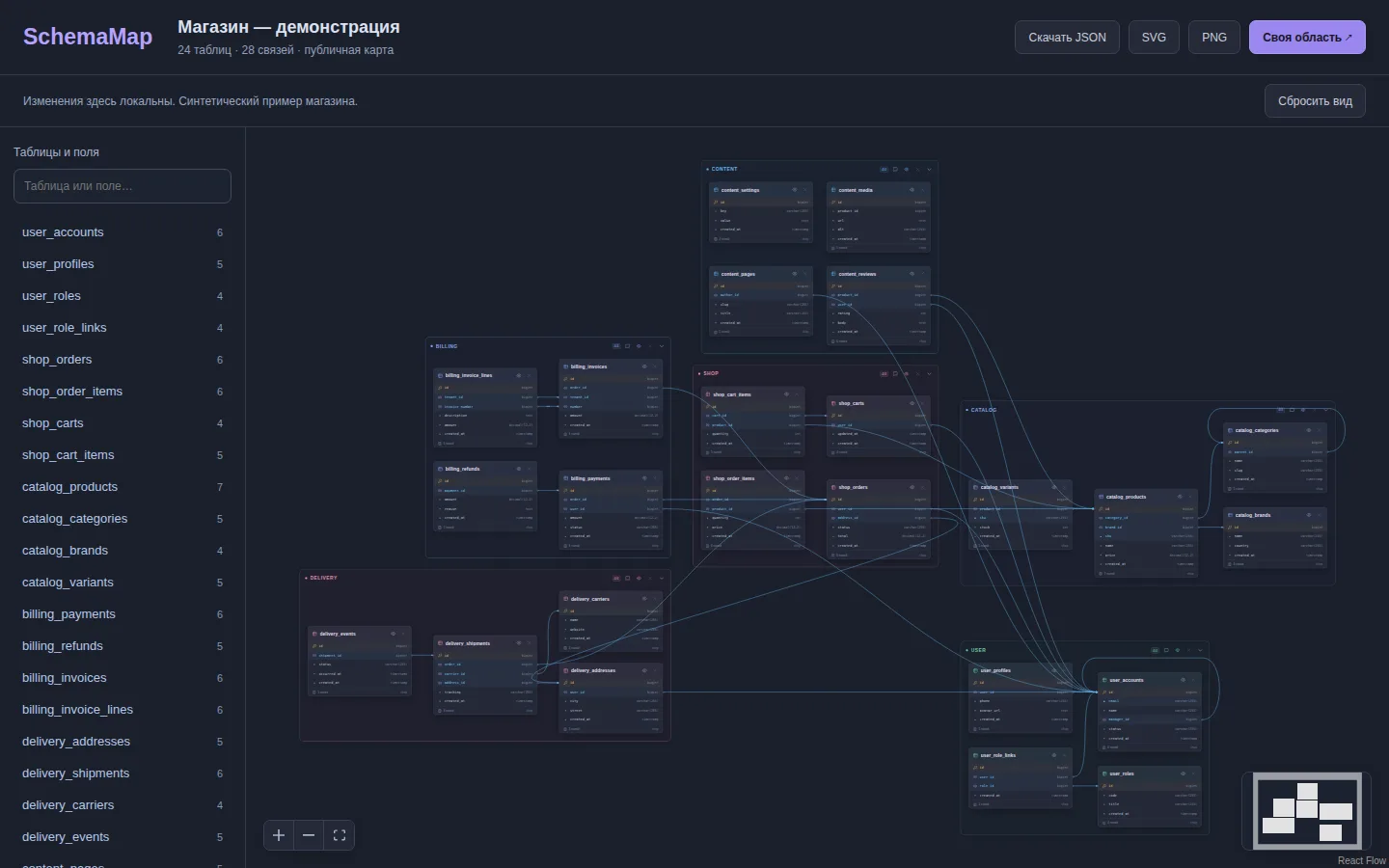
Structure and ER map
Tables, columns, types, comments, composite and self-referencing FKs.
Verified catalog: ER maps, FK/JOIN navigation, tasks and sheets, plans, collaboration, MySQL/JSON, exports, MCP/REST and attachments.
SchemaMap 0.14.0 · Updated · The editor uses Russian UI labels, shown as written.
SchemaMap explores an existing structure rather than acting as a SQL client. The catalog below describes implemented features, with instructions and limits for each. Changes depend on area roles and connected-client permissions.
Tables, columns, types, comments, composite and self-referencing FKs.
Dynamic JOIN overlay, join types, SQL/stack traces as evidence and VIEW dependencies. SQL is not executed.
PKs, index composition, available coverage metadata and 1:1 extension groups; no SQL benchmarks.
Add neighbors step by step; All / 1 step / 2 steps; hiding is separate from removal.
Table/column search, prefix/namespace and manual groups, automatic layout, pins, zoom and pan.
Independent sheets, duplicates, plan-checked moves, history and revision protection.
Shared goal, appended notes, tracker/MR/Swagger links, common object descriptions and sheet notes.
Future tables, columns, relationships and indexes across a task; no migration execution.
Owner/editor/viewer areas, invitations, revocation, scoped API keys and OAuth.
Server-side MySQL metadata reading, manual synchronization and validated JSON. Other direct connectors are not advertised.
schema.json, view.json, PNG/SVG, server history and a local queue during outages.
Shared PNG/JPEG/WebP gallery with thumbnails, fullscreen viewing and a separate MCP permission.
One invented example per table; browser reading and FK navigation, MCP/REST writes.
Shared application services, OpenAPI and generated tool schemas; pagination and revisions.
Separate chat identities, threads, questions/answers and task status; read-only worker for permitted sources.
Channels have no age deadline; explicit revocation and private own-proof retention.
No-registration synthetic map, search and export; temporary API demos only from explicitly submitted safe materials.
Import limits: 32 MiB per area, 10,000 tables/VIEWs combined, 300 columns per object and 100,000 relationships. These are input limits, not speed guarantees at maximum size. Use focused sheets for large databases. Planning does not apply DDL, index metadata does not replace profiling, and MCP does not give an agent arbitrary repository access.
Next: Database investigation use cases
Related materials: Database investigation use cases · SchemaMap documentation